LANGUAGES:  Website in English  Sito in Italiano

/ Home / Castles /


View on mapPalazzo Imperiale ed Antica Grancia di Serre di Rapolano
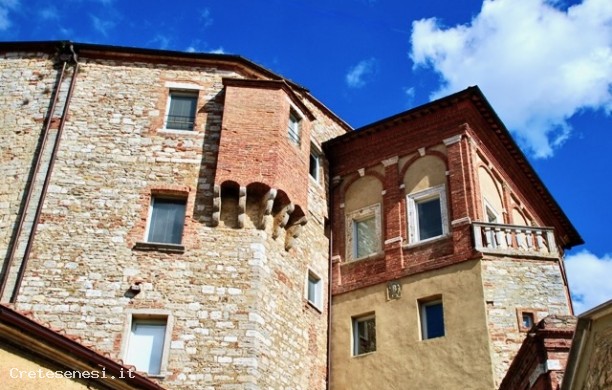
La sommità del palazzo da fuori le mura

Beside the Porta of Saint Lorenzo rises a wide, asymmetric structure which was an imperial palace, before to be turned into a fortified granary of the Hospital of Santa Maria della Scala. It was built in stages during the period of Barbarossa, who, for his descent in Italy, felt the necessity of reinforcing the castles which belonged to the Empire. The most ancient part of the castle consists of a large tower and an inferior extension which leans on the walls of the castle. Some decades later, were added to the main body two towers which stood out of the circle of walls. The palace, which, out of the circle of walls, appeared as a powerful war-machine with its great towers, on the inside, because of its opening on the street, was a public seat and gave hospitality to the administration of the imperial judges and the garrison house of the mercenary soldiers which came most of all from Germany. The palace belonged to the Empire and after 1234 to the Cacciaconti, who had its enjoyment but not its possession, which remained, at least in theory, to the Emperor. After the departure of Cacciaconti, the Palace was assigned to the Hospital(as it results from the estimate of 1318). The Hospital of Santa Maria della Scala, so called because it rose in Siena in front of the Cathedral’s steps, was a real economic power which was supported by the alms and real estate donations of private people, who wanted, in this way, to obtain a place in heaven: the donation in fact was made “pro remedio animae”. The ordinary staff was made up of friars and nuns and the marriage was allowed only if it had been celebrated before the entrance in the family, otherwise was imposed the celibacy. At the moment of the entrance you had to give all your goods and your own person in exchange for room, board and clothes. Friars, nuns and oblates(those who, even if they gave their goods to the Hospital, kept their usufruct or agreed on being assisted and kept for the rest of their life), lived into the Hospital or in the farms they were sent to. Also the rector, who was always a distinguished person, had to give all his possessions to the Hospital. The first houses and lands in Serre di Rapolano or in its court were given to the Hospital about 1270, but in 1297, after an immense donation of Bernardino D’Alamanno Piccolomini, the possessions enlarged and became a real grancia, which is a fortified place where were collected the products of the farms which belonged to the Hospital. Bernardino d’Alamanno was a speculator and an usurer from Siena, who, at a certain moment decided to use a part of his immense earnings to buy a farm and he chose the castle of Serre and its fertile court. Then he decided to become an oblate of the Hospital and to give everything to it. At the beginning of the XV century, the Cassero of Serraia had undergone serious damages by the Sienese people during the military operations against the rebel Ugo De’Rossi; after these destructions the government of Siena allowed the Hospital to build a new castle, because they didn’t want the castle of Serre to remain without a strong fortress. The Hospital was authorized to join the palace with the donjon of the Poggio, in order to build a bigger building than the old one which would have been perfect for keeping large amounts of wheat. Beside the southern front of the palace, where today there is the entrance to the Museum, there is the big door, surmounted by a very high wall, endowed with the “bertesca” to flow boiling oil on eventual besieging. The door, built at the time of the rector Paolo di Paolo Serfucci(1404-1410) was embellished in 1629, during the rectorate of Filippo Tondi, with a refined aedicule with very elegant outlines, in which today it is situated a small window ,even if originally there was a high- relief with the image of the Madonna. Underneath the aedicule there is this epigraph: (LA.) “Ut dei mustique cellae a praedeces sar(ibus const) ructae magis in dies ad egenorum auxilium repleantur undique urbem versus plus quam CCC soli staria per terna quinquennia usque in hunc MDCXVII vitibus ulmis et deis culta”. (IT.) “Because the cells of the oil and the must , which were built by the predecessors stuff more and more to help the poor people from every part of the city, , more than three hundred bushels of land for three periods of five years have been cultivated with grapevines, elms and olive trees until the present year 1617”. On the inside, just in front of the door, there is the courtyard which allows to enter the granciere’s house, the stables, the writing desk and some rooms of productions and preservation. At the end of the courtyard, nowadays there is a wall which allows only to see the traces of a portico with bricked arches. Beside the portico was created a small chapel dedicated to Saint Maria Maddalena, of which remain traces in a cave which still keeps the traces of frescos of different periods(from the XIV to the XIX century). During the rectorate of Filippo Tondi (1519-1527)was built the lateral stairs which leans an open gallery with two bricked- arches, where there is a simple Renaissance door which allowed to enter the rector’s apartment in the middle great tower. Unfortunately the roof of the loggia obstructs in part two ancient Romanesque windows which date back to the building of the palace and which are visible today only observing the palace in the middle of the covered passage which links the first courtyard to the second one. The interventions of this rector are reminded by an epigraph over the walled-open gallery, beside the coat of arms of the Hospital of Santa Maria della Scala and that of Filippo Tondi himself. Through the covered passage you reach the second courtyard with a well in the middle with a travertine well-head of the middle of the XVIII century. On the right there is the base of the great tower of the Poggio, which you could reach by means of a beat which is held up by small arches which leans on three corbels, jutting one on each other. Traces of this ancient beat are still visible in the entrance loggia of the hay barn. To the tower it is linked the L-shaped wall which comes from the first courtyard. An epigraph reminds the building enterprise: “Anno Domini MCCCCVII at the time of the venerable man Paul, the rector of the Hospital of Santa Maria della Scala”. In 1555, in one of the last episodes of the war in Siena, the count of Santa Fiora ordered to knock down a part of the circle of walls and the Tower of the Poggio, of which it remained only the base. The rector Claudio Saracini decided in 1575 to lean at the base of the tower a new rational building for the farm’s use. On the ground floor was built a big “tinaio” with the entrance on the courtyard at the end of the covered passage :on the first floor the big granary and on the top floor the vast hay barn. At the same time was built a stairway to carry the wheat to the floor of the new granary. Its spiral pattern is still legible on the outside and visible on the inside of the building. In 1790 the whole farm was sold and the building was shared among different owners. During the XIX and XX century, the building was built by the new owners as a cave, tinaio, granary and store house but it was partly divided into small apartments and rent to poor people. Recently most part of the complex has become property of the Commune, which has made restoring and has also created in its great towers the Museum of the Grancia. On the inside, the most suggestive place is the room of the rector: it was first settled in the XVI century, as we can see from a beam of 1531, and a following modernization in 1629,when, under the rectorate of Agostino Chigi, was collocated the monumental fireplace in baroque style. On the walls there are big portals decorated with stone frames with the coat of arms of the Hospital of Siena. The room is embellished with a stone -aedicule which keeps the traces of a fourteenth-century fresco and with a niche hollowed in the wall with a rich stone frame. On the highest floor there are elegant walls with nineteenth-century frescos; on the lowest floor on the contrary there is a “frantoio” for the olives which has worked until the 70’s of the XX century.

  Add to favorite places

SOCIAL NETWORKS & LINK SHARING:
FacebookDiggdel.icio.usTwitterMySpaceLiveGoogle BookmarksTechnoratiNetvibesemail


PHOTOGALLERY

Vecchia trasmissione della forza motrice a cinghiaStrettoio per la spremitura dell'olioGrandi orci per la conservazione dell'olioIl palazzo visto dalla porta di accesso al cortile interno

PLEASE SUBMIT CORRECTIONS AND/OR ADDITIONS ABOUT THIS TOPIC

Your name *
E-mail *
Thanks for the valuable collaboration

Gli aggiornamenti avvengono ogni 120 minuti.

Visualizzazione alternativa